

Tick Season is in Full Swing — Here’s What You Need to Know This Summer
Published on: June 30, 2026
By Marina Tonial, MPH, CHES®, Community Health Educator
Summer on Cape Cod means beach days, hiking the trails, gardening, and spending as much time outside as possible. But it also means peak tick season — and this year, health officials are paying especially close attention.
In April 2026, the CDC warned that emergency room visits due to tick bites are at their highest level since 2017. That’s a signal worth taking seriously, especially here on Cape Cod, where we are home to multiple tick species and some of the highest rates of tick-borne illness in the state.
The Ticks on Cape Cod
Not all ticks are the same, and knowing which ones are out there can help you stay safer this summer.
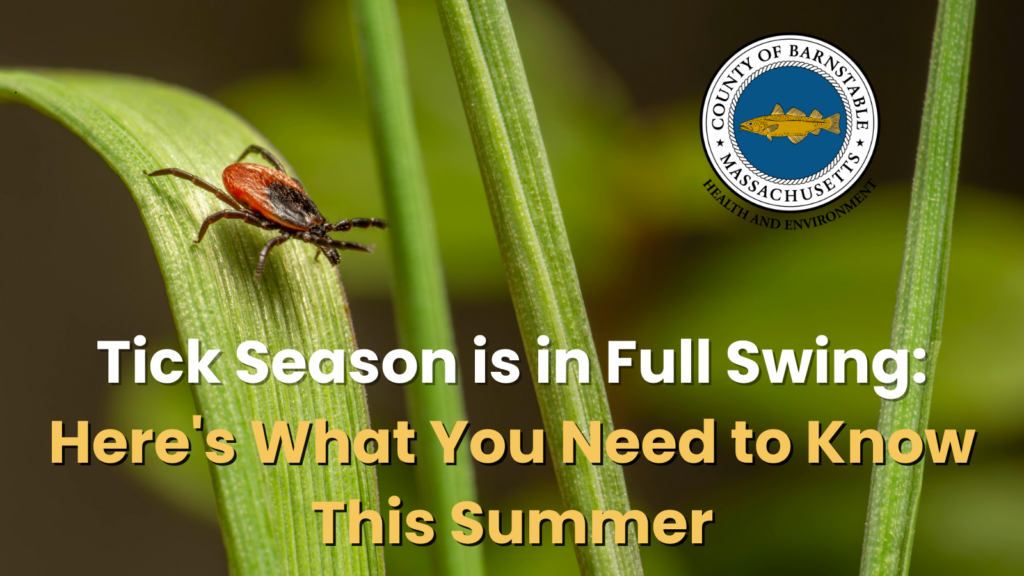
Blacklegged tick (deer tick) — The most common and most concerning tick in our region. Small and active year-round whenever temperatures are above freezing, deer ticks are the primary driver of Lyme disease, babesiosis, anaplasmosis, hard tick relapsing fever, and the rare but serious Powassan virus. Peak activity runs spring through fall, with nymphs (tiny, poppy-seed-sized ticks) most active in June and July — and hardest to spot.
American dog tick — Larger and easier to see, these ticks are active spring through fall and can transmit Rocky Mountain spotted fever and tularemia.
Lone Star tick — Once found mainly in the Southeast, Lone Star ticks have been spreading northward and are now increasingly common on Cape Cod and the Islands. They are active spring through fall, and their larvae tend to cluster together in late summer — meaning one encounter can result in many bites at once. Lone Star ticks are also linked to a growing health concern: alpha-gal syndrome (more on that below).
What Ticks Can Make You Sick
The most common tick-borne illnesses in Massachusetts are Lyme disease, babesiosis, and anaplasmosis — together affecting thousands of residents every year. Symptoms can include fever, headache, fatigue, muscle aches, and in the case of Lyme disease, a characteristic bull’s-eye rash. Most infections can be treated effectively with antibiotics when caught early. If left untreated, however, Lyme disease can spread to the joints, heart, and nervous system. (CDC — About Lyme Disease)
A note on Powassan virus: Though rare, Powassan can cause serious neurological damage and has no specific treatment. Unlike Lyme disease, Powassan can be transmitted in as little as 15 minutes after a tick attaches.
Alpha-Gal Syndrome: Alpha-gal syndrome (AGS) is a tick-triggered allergy to red meat and other animal products caused by a bite from a Lone Star tick. Cases have been rising on Cape Cod and the Islands in recent years, and as of April 1, 2026, AGS is now a reportable condition in Massachusetts — meaning doctors are required to report cases to DPH. If you’ve developed an unexplained allergy to red meat, it’s worth talking to your provider about your tick exposure history. (Tick-borne Disease Information for Health Care Providers)
Don’t Forget: Beaches Aren’t Safe Either
One of the most common misconceptions is that tick risks are limited to forests and hiking trails. In reality, ticks thrive in any area with grass, leaf litter, or brush — including beach dunes and backyards. Lone Star ticks in particular have been found in dune grasses along the Cape’s shorelines.
Prevention: The ChecksThat Matter
The good news? Prevention works. Here’s what to do every time you spend time outdoors this summer:
Before you go out:
- Apply EPA-registered repellent containing DEET, picaridin, IR3535, oil of lemon eucalyptus (OLE), or 2-undecanone to skin and clothing
- Wear long sleeves and pants, and tuck pants into socks — especially in wooded or grassy areas
- Consider clothing pre-treated with 0.5% permethrin for added protection
When you get home:
- Check your whole body for ticks — including scalp, behind the ears, underarms, belly button, groin, behind the knees, and between the toes
- Check your kids and your pets
- Shower within two hours of coming indoors
- Toss clothes in the dryer on high heat for 10 minutes — the washer alone won’t kill ticks
If you find a tick:
- Remove it promptly using fine-tipped tweezers, grasping as close to the skin as possible and pulling steadily upward — don’t twist or jerk
- Clean the area with rubbing alcohol or soap and water
- Note the date and where on your body you found it
- Watch for symptoms (rash, fever, fatigue) over the following weeks
- Talk to your provider — in some cases, a single dose of antibiotics is recommended after a high-risk bite
When to See a Doctor
Seek medical attention if you develop a rash, fever, headache, fatigue, or joint pain after a tick bite — even if you didn’t notice the tick. Early treatment is the key to preventing serious complications.
Practical Takeaways
- Peak risk is now — June and July are the most active months for tick nymphs, which are tiny and easy to miss
- Beaches and backyards count — you don’t have to be hiking to encounter ticks on the Cape
- Check yourself every time — full body checks after every outdoor activity are your best defense
- Alpha-gal is new to watch — if you’ve had unexplained allergic reactions after eating meat, ask your doctor about AGS and your tick history
- Early treatment matters — if you feel sick after a tick bite, don’t wait
For more information on tick-borne illness prevention on Cape Cod, visit the Barnstable County Department of Health and Environment at Tick-borne Illness Information and Prevention – Barnstable County
For statewide tick surveillance data and resources, visit mass.gov/tick-borne-diseases.
Sources:
- Barnstable County Department of Health and Environment — Tick-borne Illness Information and Prevention: https://www.capecod.gov/departments/health-environment/infectious-diseases/tick-born-illness-information-and-prevention/
- CDC — About Lyme Disease: https://www.cdc.gov/lyme/about/index.html
- CDC — Preventing Lyme Disease: https://www.cdc.gov/lyme/prevention/index.html
- FDA — Ticks and Lyme Disease: https://www.fda.gov/consumers/consumer-updates/ticks-and-lyme-disease-symptoms-treatment-and-prevention
- MA DPH — Tick-borne Disease Information for Health Care Providers: https://www.mass.gov/info-details/tick-borne-disease-information-for-health-care-providers
- MA DPH — Tick-borne Disease Surveillance Data: https://www.mass.gov/lists/tick-borne-disease-surveillance-summaries-and-data
Legal Disclaimer:
EIN Presswire provides this news content "as is" without warranty of any kind. We do not accept any responsibility or liability for the accuracy, content, images, videos, licenses, completeness, legality, or reliability of the information contained in this article. If you have any complaints or copyright issues related to this article, kindly contact the author above.
